Monday, March 1, 2010

Motion Capture: Reality Enhanced

Guest Blogger:
Brian Tyler Wright
Technician, Columbia College faculty

Brian Wright works as the technician in the Motion Capture Studio which is one of the features of the new Media Production Center at Columbia College Chicago. This blog post walks us through a day with Brian. More information about the Media Production Center can be found at www.columbiasmoment.org.


I sneak into the studio early in the morning. It’s still silent, before the buzz of the day starts. The heavy concrete walls are cool and distant in the darkness before the snap-flicker of the studio lights reveal them as the benign monoliths they are. A spider’s web of cables crawls along the floor, climbing like cybernetic ivy to the dozen cameras mounted high above my head. Their lens peers around my studio from above missing nothing.  

Every day in my motion capture studio starts in quiet mediation. It’s a ritual practiced alone to perfection in the red glow of the infra-red lights. The cameras must be warmed up, the suits laid out, and markers checked for imperfections. Calibration of the system is a quiet dance through the capture volume, waving a wand with three reflective balls. I await judgment. Did I do well enough this time, or must I try again?  


Silence is broken as the door slams open and I hear the jovial banter of the actors arriving for the shoot along with the directors, students, and hangers-on. They bring warmth and life to an otherwise stark space. It’s time to review and prioritize what they’d like to do today. Each actor must don a spandex suit and submit to having forty-two rubber markers covered in reflective tape strewn over their body. It looks random at first, but there is order in the chaos; each marker defines how we will track every body part. The only thing left is to teach the machine to read. 

The capture itself is a synergistic process blending the artistic with the technical. The eye of the director, the performance of your actors, and the requirements to make everything work to animate later all combine to make something new. Most actors are awkward and stilted at first in fronts of the multitude of cameras and uncomfortably revealing suit. The director must calm them and coach them to a natural, repeatable performance. Even the best performances can be rendered naught by technical gremlins; we always shoot at least twice to ensure that we get what we need. The motion capture techs must always push the agenda of what is possible or efficient to capture in their space. Certain motions, though extremely similar to the naked eye, can differ by many times in the time and complexity when it comes to cleaning the data. It’s a tug-a-war to come to a agreeable medium. 

When the day of the shoot is done, the other half of the work begins. Its reality augmented for me. I strive to capture events as they should have been. The actor provides a good base for realistic motion. The animator provides vision and a Hollywood shine to what might otherwise be a mundane move. Harder, stronger, faster, it’s all possible once you start editing. Do you need to jump 20 ft into the air? No problem. Did your actor not quite hit all there poses? No problem. You get to combine the reality of a live person with the fantasy of a purely animated character. 


Motion capture is an interesting blend of film and animation. I like to think that it combines some of the best qualities of each. It’s flexible in moving between games and feature film without much adaptation. Its’ diverse live studio and computer based formats provide a vital change of pace to keep from getting burned out on the same workflow everyday.

Brian Wright worked for 13 years in the games industry. He currently works for Columbia College Chicago as the Technician for the Media Production Center. He also teaches the Motion Capture 1 classes at Columbia College Chicago.

All images by Brian Tyler Wright

Monday, February 22, 2010

University Exhibition Development and the Gallery as Studio

Guest Blogger:
Abdul Goler
Assistant Curator,
DePaul University Museum

Exhibition design and production and all that is entailed in the development of successful shows--from the first inklings of ideas to the writing of didactic text and hanging of work to the public programming--takes on a distinct nature at the DePaul Museum.  We are a small staff within the university community consisting of three persons that share responsibilities yet also play particular roles, often overlapping duties in the process of maintaining the museum facilities and caring for the works of art in our collection.  As a result of operating parameters, we actively engage the larger university community’s expertise and areas of interest.  This allows for a kind of collaborative experience to mounting exhibitions and the curatorial process that is unique to university museums and to DePaul.  Because of this nature, in a sense, our galleries here at the museum become the working space by and in which we forge together the concepts that are initially rendered on paper.  The exhibitions are the three-dimensional fleshing out of concepts and concerns that serve to educate and often titillate our general public and the university community at large.  The DePaul University Museum galleries are laboratories that give voice to ideas.  Working with the artist Mark Curran during the installation of his exhibition The Breathing Factory provided great insight into this collaborative process that I’d like to share.

Site as production studio / production site as studio:
The Breathing Factory: A Project by Mark Curran as engaged ethnography and the implication of the subject as object 
I’d like to start by comparing Curran’s work in The Breathing Factory as currently exhibited at the DePaul University Museum to that of Greta Pratt in her series Liberty from 2009 currently on exhibit at The Mattress Factory in Pittsburg.  There is a tacit understanding in both of an underpinning collective effort, which is in fact necessary for both projects to work as multi-layered anthropological studies.  Both are tailored to specific sites and I might argue performative in nature.  Curran captures the hauntingly hollow syncopated ballet of robotic arms—along with the eerie whoosh and hum created by the machines’ programmed movement—within a high tech Hewlett Packard plant in Leixlip, Ireland.   Leixlip was Europe’s largest IT production and research and development center, modeling itself on California’s Silicon Valley.  Rather than form the backdrop to the exhibition, the large digital prints of these machines vie for prominence with the human population of workers that inhabit the plant, growing and shrinking with the needs of the global economy.  These workers present themselves and are presented within this framework as disposable as the paper “clean room” suits they must don to protect the machines from human contamination.
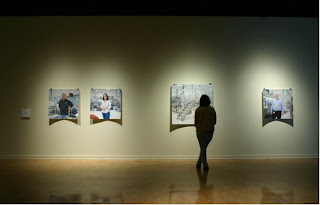

Greta Pratt’s series is also concerned with the flux of global markets, but deals with a more downtrodden collection of workers who have turned to performing in and of itself in order to make ends meet.  Pratt photographically documents individuals who wave at passersby and dance on street corners wearing full-length Statue of Liberty costumes.  These “wavers” work for Liberty Tax service.  Most were formerly unemployed, some were homeless, and all according to the artist, who conducted first hand interviews, happy to have a job even if it entailed dancing on a street corner.   Thankfully, the artist redeems these individuals through the use of portraiture situating them within the American urban landscape in a composed dignified manner, turning them into the iconic symbol of Liberty itself.

  
 Artist: Greta Pratt; Title: Liberty, 2009; from the Likeness exhibition at Mattress Factory. Image courtesy of Mattress Factory; Photo by Tom Little

Both sets of images share similarities in their use of portraiture captured through digital photography, and both situate the production of their work in site-specific ways, as well as the use of the interview process in revealing the inner workings of the subjects.   Both groups of work also rely on the space in which it will be shown and is tailored not simply to fit each venue, but to meet the intellectual needs and framework of each site.  

Curran’s exhibition however is different in its tone of almost stoic resignation in the face of seemingly unstoppable capitalist interest.  Needless to say, this gives a very wry twist to the work.  The initial ethnography was initiated and completed in 2006 when Ireland was still riding the high crest of the wave of its economic boon.  The work is prescient really; looking at the images of the workers and reading their collected interviews following the aftermath of the global economic meltdown one can’t help but wonder where they are now and what has happened to them.

The workers he portrays stand stone-faced to meet you eye to eye within the factory that is their source of income, but also their undoing. This is the unsettling environment that one enters when walking into the galleries at the DePaul University Museum. One enters the factory and through the use of various tools becomes a part of the factory; the museum apparatus the artist uses subjugates the viewer to the role of object because they act as the means by which the viewer projects his or her self into the machinations of the global economy. We are forced to consider the wide sweeping impact of the financial downturn and whether or not its full effects have been felt or are still yet to come.


The artist provides many methods for viewers to engage with the exhibition that manipulate and distort the nature of museum displays.  I found the hanging of the large format c-print photographs to be one of the subtlest manipulations of museum technology in the exhibition.  Rather than insist, as most artists probably would, upon the framing of the images to protect them from potential harm, the vivid images were hung with a combination of bull clamps and dry wall nails. In the repositioning of some of the photographs it became clear that the paper medium upon which the digital images were printed was indeed fragile, as the shifting of the bull clamps left corners and seams abraded. The result of the hanging, the artist confided, was that the images would convey a more tangible sense of vulnerability as they quite literally hang precariously by tooth and nail, trembling at the slightest vibration within the gallery. The labels for the photographs are also hung in the same manner, lending these objects a highly ephemeral quality, somewhat akin to tissue paper in the wind. 

While the large photographs seem to represent the “art” I would argue that the factory and the inner lives of the workers are truly illuminated through the presence of the documentary materials the artist developed for the exhibition which included digital displays of video of the factory and a power point presentation of office workers in their cubicles. One of the most interesting appropriations of museum technology is the stack of eight and a half by eleven-inch double-sided pamphlets printed in small type and folded into eighths. Displayed on a pedestal under a low hanging bare halogen light, most visitors assume it is an art object and don’t bother to pick one up and read it, let alone take one with them. While Curran’s stack directly references Felix Gonzales-Torres’ use of the ephemeral and the absurd, it is the real utility of the object that is most important here. This museum brochure like publication has such information as a map of the Dublin metropolitan area including Leixlip, a bar graph comparing the political, economic, social, and personal indicators among leading industrial nations, quotes from economic policy makers and theoreticians regarding globalization, and most importantly interviews with workers at the Hewlett Packard plant about their experience working in the “most globalized economy in the world.”

The presence of such materials disallows for a neat sense of distance or bifurcation of the experience into viewer and viewed, but instead works to entangle the viewer with what is being viewed. This further charges the site-specific nature of the exhibition as an interactive one and undermines its typical nature as a spectator event. Despite the sparse nature of the work and its display, one leaves the exhibition affected not so much by the “art” per se, but by the documentation of the effect of the global economy on people’s lives. The photographs work in tandem with the other aspects of the exhibition to create a sense of a lived shared experience, or a gestalt view, which is the art.   


Tools used in exhibition:
Projection of still images of office workers in cubicles at the plant (digital projector, white Mac Book, DVD)
Projection of digital video capture of machines shielded from view behind a curtain of plastic with sound (digital projector, DVD)
Projection of Power Point display of interviews of workers (digital projector, DVD)
Digital display of robotic arms in motion (white Mac Book, DVD)
Notebook of collected “hand written” notes of workers’ accounts (facsimile)
Series of ethnographic accounts professionally printed on architect’s paper for distribution stacked in gallery on table
Audio Sound track of ambient factory sounds (CD)

Working with the artist for the installation, the importance of the conceptual nature of the exhibition became apparent. The framework of the exhibition was to act as the means of telling and sharing stories, of which many were told over the course of four days of positioning work, hammering in nails, painting surfaces, and plugging in cables. Some of the stories told were ghost stories, which seemed apropos given the faded glory of the once mighty Celtic Tiger that loomed large over the project. The looped continuous projection of digital video of a plastic curtain presumably hiding a machine from view further highlights the haunting nature of the exhibition. The plastic curtain in the video is comprised of two pieces of material taped together in a pattern that our director Louise Lincoln commented as being almost suture like in appearance. Staring at the moving image, we watch hopelessly bewildered as this ghost in the machine rattles and hums, “breathing” ominously behind the curtain. 

It follows the pulse of the market and can change over to six or seven days of production overnight, uses market opportunities and risks optimally to create value. The break-even point in capacity usage remains low and market peaks can be taken as well. When the production process becomes flexible, then working hours and working conditions must also become flexible. Not only on the factory level. The new ‘breathing rhythm’ must also make headway at the social level: the time rhythm in society, the labour market, the educational system and the remaining institutions of the welfare state.

The target is a breathing factory
(source: Peter Hartz, Chairman, VW (1996) The Company That Breathes: Every Job has a Customer)
cit. in Curran, 2010 


The fact that Curran generated the idea for The Breathing Factory through the course of working on his doctoral degree through the Centre for Transcultural Research and Media Practice at the Dublin Institute of Technology also positions the gallery as a space for critical inquiry into the nature of shared experience as it unfolds within a museum setting.  Over the course of the exhibition’s run I will digitally video the installation in order to capture the comings and goings of visitors within this mix of ambient, visual, and textual cues.  This will be done not just to archive the event, but also to learn how people interact with the exhibition and if the tools used provided visitors with the means to make sense out of the exhibition.   In this way, The Breathing Factory becomes a site by which new knowledge is both accumulated and generated.

A native of Detroit, MI, Abdul Goler is the assistant curator at the DePaul University Museum and a budding scholar of the work of Romare Bearden. His specialized areas of study and inquiry include critical race theory, museum education and interpretation. Abdul completed his M.A. degree at Seton Hall Univesity and was an Academic Year Intern in the department of Modern Prints and Drawings at the National Gallery of Art, Washington, D.C.

Image Credits (all excluding image from the Mattress Factory):
Photo by Dominick Fortunato

Monday, February 15, 2010

Creating a Sense of Place

Guest Blogger:
Rey Colón, Alderman
City of Chicago, 35th Ward

My memory of appreciation for the arts began as an 8 year-old.  I was a member of the Logan Square Boys and Girls Club at 3228 West Palmer in the late 60's-early 70's.  The Club made it a priority for us to experience drawing, oil & water color painting, outdoor mural projects, sculptures, gardens, ceramics, photography, singing and dancing just to name a few activities.  I personally don’t profess to be good at any of them today, but at the time I thought I was good at them all (dancing excluded). I sold my first and last painting at age 11 for 20 bucks.  At the time, my art instructor said; "You are now a professional artist."  I was happy to be a professional anything at the moment, but didn’t make much of it.  While I have always maintained an appreciation for arts throughout the years, my craft became the delivery of a variety of programs that served the needs of neighborhood children and their families.  Since then, I have had the honor of serving in organizations like the Boys and Girls Clubs of Chicago, the Chicago Park District and the YMCA of Metropolitan Chicago prior to being elected Alderman in 2003.   It doesn’t sound very artistic, but I have always ensured that arts and culture were fundamental program offerings.  


In my role as Alderman, I’ve determined that the combination of delivering needed city services, taking a stand on issues, balancing the diverse interests of constituents and involving all interested parties in developing the neighborhood’s future is my art form.  Fortunately for me, my studio is the 35th Ward and I am an active partner with many other groups and individuals interested in expanding arts, culture and designating areas for that common purpose.  One example is the 6-story Morris B. Sachs Building located at 2800 N. Milwaukee Avenue.  The city purchased this historic building and put out a request for proposals to have it renovated.  Construction will begin this spring and soon it will be known as the Hairpin Lofts.  Retail will remain on the ground floor level; a community art center will occupy the second and affordable live-work rental space on the next 4-floors above could be an attraction for artists. 

From 2003 to 2007, I worked with local artists and organizations to produce the Palmer Square Arts Festival.  The idea for this event was not unique. I simply continued the concept of other artists before me. The original Palmer Square Arts Festivals occurred for over 15-years sponsored by a group called; Chicago Neighborhood Artists CNA. CNA was headquartered in the Logan Square Boys and Girls Club under the leadership of then Club Director Jose Zayas and Program Director Theresa Pacione.  It was through their commitment to the arts that I was greatly enriched with such diverse opportunities.  Once elected Alderman, I decided to revive the Arts Festival and continue this local tradition.   


2008 was a transition year. Palmer Square underwent construction for a boulevard renovation project as part of the Logan Square Open Space Plan.  The Palmer Square site plan included a public art installation to function as a sculptured children’s play area.  Under the direction of the Chicago Public Art Group, neighborhood children and their parents attended workshops and were involved with the design.  Today this play area is themed after the Velveteen Rabbit and surrounded by a new running track.  


While the Palmer Square Arts Festival was deferred, a new bicycle event came to Chicago called; "Tour de Fat." This bicycle extravaganza sponsored by the New Belgium Brewing Company was introduced to Palmer Square during the 2008 renovation and continues to attract thousands of people throughout Chicago.  Tour de Fat will return for its 3rd year June 2010.  


The Palmer Square Arts Festival’s organizing committee consisted of local artists representing; "American Theater Company, Chicago Ballet, Elastic Arts Foundation, the Puerto Rican Arts Alliance and the Voice of the City.  In 2008, they encouraged me to take the next Palmer Square Art Festival to Milwaukee Avenue. That same year, this group of art organizations hosted the first Milwaukee Avenue Arts Festival with limited time and resources, but the response was positive.  Last year, I reunited with this same group of local art organizations and expanded the planning group into a community-wide coalition of artists, businesses and community-based organizations to host the 2009 Milwaukee Avenue Arts Festival.  I got involved by securing sponsors, organizing logistics for a 3.2-mile stretch of Milwaukee Avenue, identifying empty storefront owners for art space and all other unfulfilled duties.  The festival was a tremendous success, but more important was the process of involving so many leaders from different areas of interest and connecting them to a common mission.


Logan Square and its surrounding areas continue to show strong signs of vitality despite the weakened economy.  In 2009, we saw new business and restaurant openings, the Logan Farmer’s Market surpassed 1,000 people in attendance, other indigenous events surfaced like Open Streets, Summer Sessions on the Square and Art in the Park.  We also have new and existing businesses that continue to attract creative people from all walks of life.  Places like Lula’s Café, Café Con Leche, Longman and Eagle (a soon to be bed & breakfast), Revolution Brewing, Tumbao, New Wave Coffee, Real Tenochtitlan, the Whistler, Weegees’s Lounge, Logan’s Bar & Grill, Dunlay’s, Brand’s BBQ, and many more either here or on the way. As we continue to create a sense of place, people with high-morale are walking the streets.  Meanwhile the list for requested 2010 events keeps growing.  I recently commissioned the formation of a neighborhood council to provide comprehensive public relations for local activities and promoting the community in a positive light.  The “Independent Artists & Merchants of Logan Square” or “I AM Logan Square.” will advance economic development opportunities while maintaining a diverse coalition of artists, business leaders, chambers of commerce and community organizations. 

There are many exciting art projects taking place in my studio these days and I look forward to being part of many more in the future.  


Alderman Rey Colón is a lifelong resident of the 35th Ward serving the Avondale, Humboldt Park, Irving Park, and Logan Square communities on Chicago’s northwest-side. He attended Darwin Elementary School, Carl Schurz High School. He studied radio broadcasting at Columbia College and completed the Community Management Program in the Office of Public Administration at Roosevelt University.  Since the 1979 murder of his brother in a drive-by gang shooting, Alderman Colón has dedicated himself to giving children and families alternatives for improving their lives. Alderman Rey Colón has devoted his career to creating opportunities for residents in the 35th Ward. He has served the 35th Ward as:
  • Executive Director, McCormick Tribune YMCA, where he facilitated a $7.5 million fundraising effort and directed construction of the YMCA in Logan Square;
  • Executive Director, Logan Square Boys and Girls Club, where he launched a volunteer program to provide mentors for inner-city youth and received the National Honor Award for Program Excellence two years in a row for community outreach and a Satellite High School with a 90% graduation rate.
  • Area Manager of the Chicago Park District, where he directed the operations of 45 city parks and play-lots, beautified public green space, and piloted innovative programs throughout the Humboldt Park/West Town communities, which are now implemented city-wide.
  • Alderman Rey Colón was elected in February, 2003; he continues to serve his neighbors by improving the quality of life in the 35th Ward.
    For more information or to contact Rey Colón:  35th Ward Community Service Office  2710 N. Sawyer Ave. Chicago, IL 60647 Email: reycolon@cityofchicago.org  Phone: 773-365-3535   Fax: 773-365-7391
Image Credit: All photos by Martha Ramos
Image Captions from top to bottom:
Alderman Rey Colón accepts an award
Boys and Girls Club booth
Palmer Square Boulevard Festival - Beverage Garden
Palmer Square Sculpture Playground
Tour de Fat
Milwaukee Avenue Arts Festival - main stage
Milwaukee Avenue foot traffic

Monday, February 8, 2010

The Studio: A Sanctuary to Quiet Your Mind in These Busy Times

Guest Blogger:
Sarah Laing
Associate director of the
Open Studio Project, Inc.
   
                         
Even though I’ve worked in our storefront studio for 10 years, every time I walk in the door, I am reminded about how much happens in our small, humble, and very special space.   Sure, I’ve felt that experience before when visiting other studios and places of production or had those “wow” moments of artistic inspiration.  But our studio is different.  We’ve set it up to be a welcoming space to make art, an emotionally safe place to create.  We never critique or comment on another’s work.  We are supportive simply by allowing each individual to work without interference.  At our studio, art is a p-r-o-c-e-s-s – not a product.  And in these stressful times, our studio/process provides a creative outlet to help reduce stress. It’s the place I go to stop, listen, and create. 


You can feel the energy in our studio.  It is very much alive.  The walls have something to do with it.  They reflect the outlines of paintings and pieces by many artists who have shared that space, inviting others to give it a try.  It provides a visual framework for going beyond, for coloring outside the lines. We set out materials such as oil pastels, tempera paints, and plaster with a purpose in mind – in order to help artists to play, explore and experiment.  In addition, to promote sustainability, our artists also use many natural, found objects, and recycled materials.

            
As an artist/facilitator, I help others honor and embrace the creative space. We model how to use and respect materials and how we, as artists, take our own creative risks.   But there is no judging.  No evaluating. We set up the studio space in a way that individuals have a sense of openness, encouraging them to find within themselves that element that asks to be expressed visually. We talk about drawing, for example, as making marks on paper, which is easier to do when the studio space is designed to encourage it.  And we talk about following your creative impulse – and how the studio space can nurture and support that spirit of spontaneity. 


We teach about boundaries by arranging a space appropriate for groups. In listening and creating without commenting on each other, we learn to respect and value each other exactly where we are in the creative process, and in our lives.  We learn that it is possible to explore at whatever level we feel comfortable, what we think and feel in a social setting, without trying to anticipate the thoughts and reactions of others.  In short, we learn to let everyone be, but be together.  And after a while of practice, we learn how to trust ourselves and each other in a way we can generalize to our lives.  


Along with making art, the Open Studio process offers a writing component that gives each individual the opportunity to clarify their own intentions for creating.  After making art, participants/artists/individuals “witness” their work -- as a way to reflect and make a deeper connection with what they created that day.   


The following questions were directed to three Panelists who are Artist/Facilitators at Open Studio Project.  This panel was held in conjunction with the Facilitators Exhibition opening on Friday, February 5th.  

1. How does the studio no commenting/critique emphasis effect your work?
      I wouldn’t be an artist if it weren’t for open studio.  I can make whatever I want and it means a lot to have this rule in place. No one tells me what to do and what not to do.
     Janet Beals Orejudos

      I was a glass artist focused on technical work. When I came to the studio I thought there was more for me in the art making process.  The no comment rule allowed me to be with my thoughts and myself in relation to art making.  My process came from inside rather than outside sources.  
     Cal Calvird

      I feel a profound sense of support from the groups in the studio.  I don’t have to verbally or conceptually express that. It’s about connecting with myself and the universe.  There’s a quiet support from everyone.  It’s revolutionary.  I’m amazed for having been able to do this for so long.
      Ted Harris


2. How does the studio’s community element make this art making setting different from other art classes?
      This community and its sense of intimacy create a deep connection to people who you don’t know very well but are sharing an experience with them.
      Janet Beals Orejudos

      I really think about the connective process when thinking of community.  It’s so empowering.  All I have to do is show up and see how it unfolds.  There’s no consensus in the room but there is equal support.  It all unfolds in a great way.
      Cal Calvird

      Referencing creates a nonverbal intimacy that you can look at others work and do what they’re doing and it doesn’t matter.  We don’t often sell our work made here, so our relationship with the art world is complicated in regards to that.  Making a living as an artist is kind of off the table when I’m here.  This is completely different. It’s better.
       Ted Harris  

3. How does this studio environment impact your choice of materials?
      I don’t make art outside the studio. I use the materials here.  So it depends on what is here.  I love the materials, I use them, but I don’t bring anything from outside.
      Janet Beals Orejudos

      They’re inexpensive.  There are a lot of found objects.  As adults, we don’t want to waste the materials, but here we have to use it, there’s constant encouragement to use and then reuse the materials.  It’s very freeing and very liberating.  
       Cal Calvird

      Every single time I come to make art, what I need seems to be here.  There isn’t so much effort.  Whatever is here is going to work for me.  I also observe what other people use and I find myself gathering those found objects.
       Ted Harris 
 

Sarah Laing is the Associate Director of the Open Studio Project, Inc. She has a Masters in Art Therapy from the School of the Art Institute of Chicago and a Bachelors in Studio Art.  She has directed numerous programs and exhibitions for a range of populations which celebrate the affirmative impact of the creative process to make social change.  She is a strong advocate of community youth, the arts, and mental health awareness.  

Image credit and captions top to bottom:
Store front of Open Studio Project. Photo by Jill Brazel Photography 
A sample of a wall at Open Studio Project
Found object art work by Open Studio Project Artist/Facilitator Karla Rindal
A drawing workshop at Open Studio Project
A sampling of materials arranged on shelves at Open Studio Project
Storefront. Photo by Jill Brazel Photography


Monday, February 1, 2010

Home as Studio and Canvas - A Defense of Martha

Guest Blogger: 
Katie Hawkey Swindler
Organizer of Swap-O-Rama-Rama Chicago

October 15-17 the American Craft Council welcomed the growing community of "indie-crafters" and "DIYers" to their workshop: Creating a New Craft Culture. As an avid DIY-girl and organizer of the annual, indie-craft inspired Swap-O-Rama-Rama Chicago, I immediately planned to attend this event.

Rounding out a program of fairly academic presentations on modern American crafts, were a few brave speakers who delved into the emerging indie-craft movement and quickly sparked heated discourse about standards of quality, new online market places, and generational divides. The combination of “old-school” and “new wave” crafters was a veritable powder keg.

Throughout the conference there were two words that – once uttered – turned a room of hippies, hipsters, artists and scholars into two packs of snarling wolves – “Martha Stewart”. 

Martha Stewart - Inspiring DIY or Evil CEO?

Some attendees vocally despised Martha – they saw her as relegating "craft" to low-brow, homemaker-hobbies. Many of these craftsmen had spent their lives making "Craft" synonymous with "Art".  As one woman put it,

    “She has no place in a legitimate discussion of Craft. End of story.” 

But the indie-crafters defended Martha, citing her as an empowering "maker" who started them on the path to their own home-based craft businesses. I overheard a woman mutter behind me,

    “Martha Stewart is a gate-way drug." 

I tried to hear both sides of the argument, but I must admit, my personal love for Martha Stewart Living, Trading Spaces and This Old House made me biased. I've long been inspired by these TV shows because they treat the home as both studio and blank canvas. They tell their viewers that they deserve to be surrounded by art, beauty and handmade items to which they can share an emotional and physical connection.  One might even argue (and I certainly have) these programs teach their audience to view their home and their belongings through a craftsman’s eyes:  seeing the hidden potential in the materials that surround them. 

The programs educate and encourage viewers to do-it-yourself. Take risks, and “make” – in their living spaces, using found objects and everyday materials. Every room of the home becomes a studio and every thing in the home; a potential craft.

 
A Door as a Headboard

From Trading Spaces I learned to see that a door taken off it’s hinges could be a headboard. From Martha Stewart Living I learned that an unused vase could be smashed and grouted to create a mosaic table top and enjoyed every day. From This Old House I learned to appreciate the handcrafted furniture in my home, and how to repair these heirlooms instead of replacing them with something cheap and mass-produced. 

All of these programs (at least before they started their own line of products), taught us to be “creators not consumers.”  This inspiring phrase, taken from Swap-O-Rama-Rama, is a central tenant of the DIY ethos.

When you learn to see like a craftsman, then every screw, spork and sofa in your studio has the potential to become the medium for your art. How many of us, while deep in the creative process have glanced up for inspiration and seen before us ”the perfect thing“?  That piece or item immediately snatched off the shelf (or off the floor, or out the garbage) – and incorporated as the pièce de résistance. Then your home has become your studio and, at the same time, your home becomes a work of art.

I’m not saying that someone’s artistic education should begin and end on HGTV, but I would say that these shows have given permission to the craft-curious to try their hand at “making”.  They have helped expand the idea of where and when “making” can take place and thereby have made the studio accessible. 

Removing our judgments – and definitions – opens our minds to be creators. If we say “This is a vase” - than it can never be a mosaic table top. And if we limit “what is a studio?” then we might miss a world of art.

Katie Hawkey Swindler is a maker, marketer and craft-enabler.   Her life-long loveafair with Chicago has made her an evangelist of audience development for Chicago theatre, dance, art and the emerging indie-craft movement.  She is inspired everyday by the oh-so-Midwestern practicality of the indie-crafting community who not only tells everyone to “Do It Yourself” but empowers them with shared knowledge, tools, encouragement and marketplaces. 

Images from top to bottom
Swap-O-Rama-Rama Promotes the DIY Ethos, design by Kevin Reed, Vin designs
Martha Stewart - Inspiring DIY or Evil CEO?, design by Kevin Reed, Vin designs
A Door as a headboard, photo from Apartment Therapy


Monday, January 25, 2010

Pondering a Few Studios of the South

Guest Blogger:
Lisa Stone
Roger Brown Study Collection Curator


For a long time I’ve been rooted in the notion that much inspiring work is inseparable from the sphere of home and life, made by artists for whom home = studio, where the boundaries between home, life, and art are irrelevant if not nonexistent. To put it another way, some of the most compelling creative work I’ve encountered orbits centrifugally around the maker’s home place / home life; the mainframe art world is not the gravitational center, nor is the work directed to that world, that audience.

I didn’t arrive at this by being disenchanted with the main frame/mainstream. I’m engaged by art that originates from many places including that one, but I continue to have the richest experiences in the places where creative people make work that’s more life specific than site specific, at in the 70s sense of the phrase.

Having spent the last 25+ years seeking out and visiting artists’ environments I’ve become just a little jaded, occasionally feeling that I’ve seen, or at least know about the exceptional examples. Jaded is exactly what I don’t want to be, so I’ve had the great good fortune––somewhat out of the blue––to encounter surprising sites at almost every turn, throughout the last year and the beginning of this one.

I just returned from a kind of pilgrimage to southern California, where reinventions of the studio erupt naturally and unexpectedly, as if from the fault line itself.  Simon Rodia’s Watts Towers, the miracle-incarnate––for what they are and how they endure––are looking better than ever, and the world looks better from and through them. The Towers’ radiating influence stretches from its early (post-Rodia) history, as a beacon of hope during the 1965 Watts riots. Noah Purifoy and others established the Watts Towers Art Center as a response to the conditions that caused the riots (all of which profoundly directed his creative life, but more on this in a moment). 40+ years later, the Watts House Project is an inspired, contemporary endeavor under the direction of artist and organizer Edgar Arceneaux. In case my original point was momentarily lost, the Watts Towers complex grew out of Rodia’s home and garden––literally––at 1765 South 107th Street, Los Angeles, between about 1921 and 1954, as an ingenious and original expression of organizing space, architecturally and sculpturally, texturally and colorfully, symbolically and tangibly, operatically and soulfully. It means many things to many people, and was one of the agents that forced the 20th century to reconsider the no-longer-workable definitions of architecture and sculpture as mutually independent. It triggers an archetypal awareness of ground and sky. (I couldn’t do the Towers justice with any number of words, so please take my sincere advice and visit the site as soon as humanly possible, if you haven’t already.)


The pilgrimage went beautifully off track, and from the Watts Towers we were directed to “The 10th Wonder of the World”, at 1145 West 62nd Street, a modest neighborhood not too far from the Towers. The world keeps churning out its wonders, and the makers of this one––Lew and Diane Harris––confidently believe theirs to be in the top 10.


You figure there’s a house in there somewhere because it’s on a street lined with bungalows in a neighborhood filled with houses, in a city, etc. But then you’re not quite sure. It takes a few minutes to recognize the peak of the 2nd story gable—the only clue that there is indeed a house in there––since the space where the yard would be is so completely and densely occupied with stuff––big stuff and tons of it––stacked high, robustly arranged, and unified boldly with black, white, and red. Using leverage (the explanation for how they moved colossal sections of iron pipe and other industrial materials to their project), Lew and Diane created a composition of vertical upright cylinders, some topped with spinning industrial fans. There are airy open-work globe forms and curious melted amorphous objects. The whole arrangement is bordered along the sidewalk by a line of clear acrylic fence posts, a delicate touch. Memorials to Michael Jackson abound in Los Angeles, and the single narrative element here is a standing portrait (likely a memorial) to Jackson, incised in a jumbo piece of clear acrylic.


Lew described the process of finding industrial materials––specifically the large steel cylinders––and the metamorphosis that occurs when horizontal cast offs are moved to the new context of their yard and positioned upright. He mentioned the experiential power of color and verticality. He hinted at the purpose of their work: to give objects identity and meaning.

It’s easy to miss the narrow, winding path that leads from the sidewalk to the house. It’s flanked by tall walls of stuff––paper, rags, you name it, stacked so densely that it’s not clear if it’s actually navigable. No telling what’s in there, or even if the artists go into the house. The street side of the sidewalk seems to be the primary studio/living space, with sheltered seating, storage areas, and a packed-to-the-gills truck that may also be a living space. We found the artists there, and it appears that they spend much of their time there, working, and hosting the occasional wonder seeker.


The pilgrimage continued about 125 miles east to the high desert near Joshua Tree, to the Noah Purifoy site. (There are various names for it which I don’t mention as I’m not certain what the artist called it.) Purifoy (1917 – 2004) moved to the desert from Los Angeles in the mid 1980s and spent the next 20+ years building immeasurably poetic structures and objects throughout his 7 ½ acre open air desert studio. Purifoy worked with cast off things as well––a challenge, in that nearby Joshua Tree recycles just about everything. Knowing this fact gives his inventory of materials the distinct sense of rescue and transformation. (I guarantee that you will not find more beguiling sculptures made of cafeteria trays if you search the world over.) The constructions are at once an entire site and a collection of many individual tableaux and one can wander for hours through them, beholding the total of it, as meanings multiply and compound at each setting. Most of the constructions are larger-than-life (taller than us), tenuously held to ground by guy wires. The wind is high and the elements move, shake, and sing under the blasting sun and sky.

Purifoy was engaged in the L.A. art scene for years, and Kienholz associations pop up regularly, as both artists shared a knack for squeezing the life out of previously used materials and giving them new form.  Purifoy built an homage to Frank Gehry, and other tableaux may honor other artists. Purifoy’s trailer and surrounding garden are somewhere near the center of the site, and at some point Ed Ruscha built Purifoy a ranch house across the road, perhaps so he could get of the studio now and then.

Being there, the flash of sun glints kaleidoscopically around metal and wood, old clothes and tires, and the wind never ceases. The world closes in on this one place for the moment and you could be a Tibetan monk high in the Himalayas, flags flapping, meditating on a prayer wheel. The experience of wandering the site is exhilarating and a bit haunting. The tableaux are instantly fulfilling––they trigger pleasure and deep thought––and the opportunity to wander through acres of them is a true gift.

Lisa Stone is curator of the Roger Brown Study Collection of the School of the Art Institute of Chicago and teaches in SAIC’s Department of Art History, Theory and Criticism. Primary work concerns the documentation, preservation, and interpretation of artists’ environments. Personal work concerns a garden/ruin in Spring Lake, WI.

Images from top to bottom
“65 Aluminum Trays”
Detail, Simon Rodia’s Watts Towers, Los Angeles, CA
Overview, 10th Wonder of the World, Los Angeles, CA

Path to the house, 10th Wonder of the World

Lew and Diane Harris, h Wonder of the World


Monday, January 18, 2010

Out The Door and On The Move


Guest Blogger:
Karsten Lund
Curator and Writer

Years after the arrival of so-called post-studio practices, we've returned for another look at the fixed, grounded environment of artist's studio. I'm interested in trying to align changing perceptions of the studio and the rise of other models of art-making with broader cultural shifts and technological developments. A number of contributors to Studio Chicago have referred to the myth of the heroic artist working in isolation — within that narrative framework the studio is a refuge apart from the world. It's these ideas of disconnection and immobility that I'd like to explore and push against.

Reading between the lines in most analyses of the studio's fate, you'll find that a lot of non- or post-studio art practices rely on a growing mobility, the rising prevalence of travel. Travel gradually became commonplace for artists and the everyman alike. Furthermore, I'd venture that the other side of the coin is the ever-evolving media-technology that brings the big world to us.

It seems safe to say that over the last century, innovations in transportation and telecommunication technologies have led to substantial changes in our culture and even altered our individual ways of experiencing the world. As far back as the late-19th century, with the introduction of the telegraph and railroads, there was talk about how these inventions spelled "the annihilation of space and time." That sounds hyperbolic now, but it signaled the start of something: distances gradually contracting and long durations compressing into the instantaneous. By the 1950s, air travel and television had taken hold, which led Martin Heidegger to observe that a sense of "distancelessness" was encroaching on people's lives.

One could argue that in the decades after that these shifts toward greater mobility and media exposure inevitably affected the kind of artwork being made. Site-specific work, for instance, became bounded to particular places, and artists went off to make Land Art in distant locations. You have to travel to the site or else learn about it through documentation, published descriptions, mediated forms. With new technologies, the wider world starts creep into the home and office more and more; people head to the airport and out along the highways; artists leave the studio. 

Linking these developments together seems like less of a stretch when you note how these questions of mobility feed into more recent art practices, practices that now epitomize a post-studio era. But first, consider the last decade or so: the internet dramatically changes how we relate to each other (across distances); air travel is now totally ubiquitous; statistics show people relocate from one city to another with much greater frequency than a couple generations ago; buzz moves faster and further than ever before. As everyone adjust to new heights of mobility and mediation, so do artists.

In One Place After Another, Miwon Kwon observes that vanguard, site-specific art practices began to center on the movement of the artist, who becomes a nomad on a circuit of biennials and site-oriented commissions. Related ideas even poke through in curator/writer Nicolas Bourriaud's repeated attempts to describe the main currents of contemporary art. In 2002 he made the case for an art of postproduction that "seems to respond to the proliferating chaos of global culture in the information age" — and in this work, he writes, "precariousness is at the center of a formal universe in which nothing is durable, everything is movement." 

If the studio is back, are we collectively searching for stability in the face of precariousness? Are we dying for firmer footing, a chance to stand still? 

Perhaps unsurprisingly, renewed interest in the studio arrives on the heels of an economic collapse. Predominant models, in everyday life as in art, start to seem questionable. A year ago we saw gas prices rise precipitously; the cost of flights ballooned; people began taking "staycations." If America had come to take an easy mobility for granted, this was a wake-up call of sorts. Next, as the bottom fell out of the bucket, pundits even began to wonder if we were witnessing Global Capitalism's death rattle.

From one standpoint, a post-studio approach to art production might appear to be the ticket to a low-cost art practice — No rent! Less objects!— but the rising tide of well-traveled, well-known itinerant artists requires a steady flow of money. Racking up a million frequent flyer miles doesn't come cheap. And site-based commissions themselves can be highly involved, or large and spectacular. 


So, is the perceived return to studio-based practice a retreat? Back to the bunker? Or might it be a refusal of some of the very terms that have come to shape our lives — i.e. real-time media technology and an itch to stay moving? I think back now to the poster that Robyn O'Neil made for The Believer (if I'm remembering correctly), which I saw during her exhibition at Tony Wight this fall. On one side of the poster she humorously and attentively describes her studio practice, and one of the items is emphatically NO INTERNET.

Better yet, can a studio-based practice be the path to a new form of criticality, one that doesn't turn away from these evolving cultural conditions but rather explores their implications from a deliberately steady position? (After all, most of us still only travel occasionally, though we might be on the internet all the time.) 

Tentatively, two Chicago artists come to mind: Curtis Mann and Heather Mekkelson. Mann acquires peoples' snapshots from embattled places like Iraq and Lebanon, sourced via the web, and he reworks them using bleach and varnish. The resulting images suggest a strange new world, yet they also isolate elements from the original locations, amplifying the traces of real-life conflicts. Mekkelson also works from second-hand photographs, specifically pictures depicting the aftermath of natural disasters; based on these images she carefully reproduces the wreckage by hand using new materials from your local Home Depot. Both artists deal with the struggle to meaningfully engage with far away events and places that nonetheless feel accessible online or in photos. In both cases, it seems vital to the work that the artist is primarily operating in a studio setting: i.e. at a distance, with a degree of detachment, and yet responding to their sources in a physical manner — as if trying to feel it all out in a more tangible way. Last week's devastating earthquake in Haiti, and the constant news coverage in its wake, seem to underline the relevance of these ambivalent inquiries all over again.


Or is it possible that revitalized interest in the fixed setting of the studio is just another point along a certain trajectory, a predictable outcome? Media theorist Paul Virilio, with his usual dire outlook, wrote in Open Sky, "We are seeing a reversal in trends: where motorization of transport and information once caused a general mobilization of populations, swept up in the exodus of work and then of leisure, instantaneous transmission tools cause the reverse: a growing inertia; television and especially remote control action no longer require people to be mobile, but merely to be mobile on the spot."

As we return attention to the studio now, perhaps we ought to think about it slightly differently then. Maybe today's studio isn't an isolation chamber cut off from the world, as the cliché goes; the conventional workspace of the studio is yet another staging ground that aims outwards, another node in a networked world. In any case, it's a place, like many others, where we have to contend with the ripples of technology, and also with trends we tend to take for granted, whether mobilization or potential inertia. I'll be the first to admit that this line of thinking begs for a longer essay and a more thorough argument than I can provide now, but the speculative signposts I've planted here at least point to another avenue for discussion.

Karsten Lund  is an independent curator and writer, and the Deputy Editor of Flavorpill Chicago. In 2009 he organized exhibitions at the Museum of Contemporary Photography (Columbia College Chicago) and Swimming Pool Project Space. He holds an MA from the University of Chicago and a BA from Hamilton College, in Clinton, New York.

Images top to bottom
Robyn O'Neil,Masses and masses rove a darkened pool; never is there laughter on this ship of fools, 2007, Courtesy of the artist
Curtis Mann, loudspeaker (Beirut), 2007, Courtesy of the artist
Heather Mekkelson, told them to look after the younger ones, 2008, installation shot: ThreeWallsSOLO, Chicago, Courtesy of the artist