Wednesday, July 28, 2010

Searching For Meaning in Nomadic Studio

W. Keith Brown
Art Educator / Scholar / Writer
Stockyard Institute

The Nomadic Studio can be described as four months of rotating and fluctuating artistic and pedagogical actions that seek to celebrate, inform, and shape divergent cultures within the realms of art and education. The exhibition is timely in that it engages contemporary strategies in not only the city of Chicago, but across the globe. In urban and rural communities, people are inventing, conceptualizing, documenting, and collecting new materials that help them navigate personal knowledge and unique environments. Nomadic studio seeks to make visual and material connections to these people, places, and practices, thus showcasing productions of the maker and their efforts to create meaning.


On the Art
Contemporary artists are constantly developing new strategies to produce and distribute culture. The artworks displayed throughout nomadic studio are a direct result of these scattered modes of production and represent the outcomes of the latest conditions under which art is made. Over time, art studio, like culture, has undergone radical shifts in its location, square footage, and conceptual orientation. Today art studio can be just about anything or anywhere: a kitchen, bathroom, bedroom, garage, basement, storage unit, abandoned building, storefront, neighbor’s house, backyard, shared space such as home/office/studio/recording studio/editing suite, etc. Nomadic studio as an exhibition space is investigating artistic and educational practices that operate within these transitional areas and structures that affect all of us. Situations and circumstances force locations and thinking to change course sharply, which then compels the maker to adapt and respond to such abrupt movement.


How humans view and interact with space is evolving, we no longer declare certain spaces unsuitable, possibilities surround us. What was once viewed as non-resource for many has emerged as a vital mode of production for some. The variety of materials being used to make art for the opening of nomadic studio was a testament to the conceptually useful, Dayton Castleman recently used layers of cardboard to produce a large-scale sculptural installation of a fighter jet playing “Chicken” with a bird. Ian Bennett created an aerosol installation using homemade stencil patterns applying each one onto various panels and found forms to create a stimulating yet relaxing lounge nook for guests. Mobilization is a spatial tactic being explored, art strategies used in Mike Slattery’s “Mobile Silkscreen Cart” (courtesy of Ed Marzewski) and Brandon Alvendia’s “Portable Bookmaking Studio” are examples of sharing processes and resources via an abandonment of fixed location.


Other artists featured over the next few months use traditional media mixed with found objects, recycled materials, cultural fragments, digital debris, and discursive media to communicate thoughts and ideas. This mode of making is not something that nomadic studio is discovering or setting out to find, it is what people are showing us. For nomadic studio, the studio aspects of the space are taken seriously, the programs and exhibitions are interactive places of play as well as mini-social settlements, visitors will not find art that looks like a studio nor will they find hodgepodge versions of workspace. Artists are presenting work that was made under a certain physical condition unique to the artist and the piece on view.


On the Pedagogy
The educational aspects of the nomadic studio are less obvious if a visitor misses an opening or one of the many monthly programs. As mentioned above, the materials, use of spaces, and strategies of the artists are educational in and of themselves. The work is providing new ideas and perspectives on making that heretofore seemed obscure. The level of transparency for knowledge sharing is evident in the programs, zine/publication collection, art materials, SITE office, nomadic library, and the nomadic center for public research (ncpr).


Nomadic studio is following exhibition protocol by showing artwork, but it breaks with tradition by showing the viewer how to make the art she/he is encountering. Programming is a way for audiences to access new knowledge by interacting with speakers, panels, and workshops. They provide opportunities to learn from others, which is how education should be—a knowledge exchange. The zine/publication collection, nomadic library, and nomadic center for public research are all little places for guests to read, take notes, and learn. The nomadic center for public research (ncpr) has over 100 PDFs on art, education, artists, and theory all made available for public consumption via a 1999 red G3 imac. The policy for ncpr is bringing your own flash drive or (BYOFD). Other features for learning are the nomadic studio and the stockyard institute web sites. Each has resources about projects and participating artists and educators.

The SITE office is a legitimate office space in the gallery for Stockyard Institute Teaching Experiments (SITE), which is a multi-media publication effort dedicated to teaching and learning and sharing common resources through the lived experiences of educators. During SITE month in November, we will have an open office that will be reflecting, organizing, and documenting the previous month’s programs for the purposes of galvanizing future efforts for the publication. Feedback and participation is highly encouraged during that time and beyond.

In August, nomadic studio will be transforming into the Bird Sanctuary. The main gallery space will be turned into a replica of the former Chicago loft space, A\V Aerie. The Opening on 8/12 features work by: Rob Funderburk, Susan Hall, Nikki Jarecki, Christophe Roberts, Jay Ryan, Tom Stack, Erik Stenberg, and Diana Sudyka. On 8/19 come see AndrewandAndrea. On Saturday 8/21 see, Baby Teeth, Tim Kinsella and Willis P Jenkins perform on the newly constructed A\V Aerie stage. On 8/26 see Mary Mattingly and Mockhouse. 8/28 Bird Building zine release.


W. Keith Brown is a Chicago-based art educator, researcher, and writer. Aside from being an art history teacher at ChiArts, Brown is also a member of the artist-pedagogical collective, Stockyard Institute, founder of the Critical Visual Art Education (CVAE) Club, art critic for Whitehot Magazine of Contemporary Art’s Chicago division, contributor to Proximity Magazine, and editor for the Illinois Art Education Association (IAEA). 

The views and opinions expressed on this blog by W. Keith Brown do not necessarily reflect the views and opinions of those organizations with whom he associates.

Image Credit: Courtesy of Kelsey Moher


Wednesday, July 21, 2010

Burning Bridges and Dream States

D. Denenge Akpem
Performance and Installation Artist, Designer, Educator


The curatorial essay in the brochure for the exhibition at Columbia College Chicago's Leviton A+D Gallery, X-treme Studio considered the idea of genius and varied, changing definitions of "studio" over time.  As an undergraduate student, I took a class entitled "Portrait of the Artist" that focused primarily on musicians from the classical era to the present.  The class discussions centered around the concept of "genius" in reference to artists like Mozart who was revered as having a genius spark, an unknowable, unfathomable quality that enabled him to create glorious works that caused a passionate public response.   I do not believe that "genius" and “spiritual” should be confused as synonymous concepts within the realm of artistic works.  And certainly one can operate a studio as a spiritual arena where spirituality is the principle tool of creation, the very foundation.

At the curator’s request, I included sketches and images to reference my process in preparing my installation for X-Treme Studio.  One image depicts Tina Turner whose life and later artistic practice have been grounded in and transformed by her embrace of Buddhism.  The practice and discipline of Buddhism enabled her to rise up from one of the darkest periods of her life and to refocus to rebuild a new and improved life and career path.  The Buddhist tradition is rooted in part in the use of chant. Sun Ra delved into this concept of voice and sound vibration, and the revered jazz musician's work and philosophies have been instrumental to my own practice.


"In the Space of Art"
, the introduction to her recently published book Buddha Mind in Contemporary Art, Mary Jane Jacob writes

This space of art is a mental space in which we see things as if for the first time. So the mind the artist possesses in the space of art-making is Suzuki’s “beginner’s mind,” where “there are many possibilities,” while “in the expert’s there are few.”5 In art, as in Buddhism, creative potential resides in that nothing place, that nowhere of emptiness: an open space without attachment to outcome, with an aim to guide the process but the goal (the answer) kept at bay...for as long as usefully possible.

In my piece in
X-Treme Studio, I set the stage with carefully, meditatively sculpted environments that were dictated by a dream I had specifically asked for after a series of painful and mystical events.  Through the chant, I posed the question of our ability to "alter destiny" (from Sun Ra's iconic film "Space is the Place": "I am the Alter Destiny.").  The gallery then becomes the test site.  What will the outcome be and will we know it if we see it?

And/So what is the value of art? What does art do? What happens in the experience of art?...The space of art and the space of life are different dimensions of the same space. The “imaginative vision” of artists is one of the things that allows us to see and experience reality fully. Buddhist practice is another. Sometimes, as in the work of the artists interviewed here, they are connected.*

Sun Ra was a philosopher-musician who understood and experimented in the mystic realm.  What he has given us musically touches us even today whether we know his name or not.  These are tools to effect transformation...perhaps on a cellular level?  (Then again, what transformation isn't cellular?)  This speaks to a world that is not as set as we would wish to imagine it where we are reminded of Chemistry 101 when we were first informed that the lab tables were not solid mass but rather comprised of very slow moving molecules.  We understand the fusing of metal with the tool of fire, but chemistry can also be used to explain how Jesus might have walked on water (apart from the idea that he had super powers).  Is it science or spirit or both?  How much power do we have to effect physical, environmental, global and universal transformation?  Can we induce the mystical and change fate?

At its core, Performance Art plays with these questions.  It distills them into poetic actions that are extreme, sometimes violent, taxing to the physical body, strange, simple, beautiful, elemental and sometimes a matter of life and death.

Recently, in a review of Marina Abramovic's retrospective, a critic referred to a period in the 1980s of her then-partner Ulay's work as "... suffering, growing ever more calculated and heavy with cultural-tourist baggage...Performances had started to smack of religious ritual and Orientalist theater..." My question is why the use of religious iconography and/or ritual is deemed a negative.  I would posit that this has more to do with conceptions about the parameters of art/artist and of the role of art/artist than it does with the work itself.  It is a key question that's been on my mind for some time and I'd like to consider this further.

Sun Ra believed in the power of sonic vibration ("teleport the whole planet through music"), and with a similar belief I have used the work, studio, and gallery performance-installation as a testing ground.  My life is an intentional laboratory.  It is not random or unconscious.  My artistic practice is my spiritual practice. My studio is my body and my home is any space in which I am actively creating is a spiritual arena.  They are so completely linked that I don't see where one ends and the other begins.  Even my commercial design and interior projects begin with an intention of altered destiny with the creation of spaces that are literal catalysts highlighting individual movement through color, sound and material placement for specific transformation.

Marina Abramovic conceived her "goodbye" walk of the Great Wall of China with Ulay in a dream. I asked for and received the gift of a dream as I was planning my contribution to this exhibition.  I took the premise seriously: the idea of the extreme and of the studio as a site of alchemy.  The alchemic arts are associated with the Yoruba god (orisa) Ogun, the tragic actor, the artist, the one who would traverse the chthonic realm to unite gods with humans, the fuser of metal-to-metal, agent of destruction and construction.

The collection of stories, The Big Book of Giants, tells tales of a smart, courageous boy who cured a giant's fears with a pair of extra large eyeglasses.  Dr. Seuss’s The Lorax entrusts the last truffala seed, and thus the last hope for the environment and humanity, to the hands of a small child. I see my artistic practice as a way of reframing perspectives, as a precious tool, a sacred gift.  As Fela Anikulapo Kuti once said in an interview:  “You curse God if you are given the gift of singing and you do not sing.”

The danger is that the artist becomes stuck in Ogun's chthonic realm.  The essential key of what ritual does, then, is to train the self/artist/practitioner to tap into these sources, move through the creative process, and come out the other side, leaving the final change or results or work to fate.  One must continue to be an empowered vessel--empowered vessel but vessel nonetheless. In the Performance Art tradition, I am the tool.  Stripped down even from my role as "artist", when in the installation, I as a physical entity, malleable matter, am in service of the work just as simply as any other piece of the puzzle.  I step out of the studio as alchemist and become earth/light/video/paper/pillow, sculpture come alive.  I am not performing per se nor is the focus to be on me, my personality, my self-hood.  Rather, I am a stand-in, a piece of the whole, a living object in a mystical diorama of sorts.  My installations function with and without this living object though differently in each case.  And in addition, the audience can also become this object; it is not "artist" specific.

*Excerpt from "In the Space of Art", introduction to Buddha Mind in Contemporary Art, edited by Jacquelynn Baas and Mary Jane Jacob, featuring references from  Shunryu Suzuki Zen Mind, Beginner’s Mind and Mark Epstein essay “Sip My Ocean: Emptiness as Inspiration."


The Narratives of Works from
X-Treme Studio

"Burning Bridges (Gift #1):  Exercise for Banishing Palpitations and Regaining Perspective" and "The Dream (Gift #2):  Meditation Metaphor, Illustrated"


These two works draw from indigenous traditions as in the preparation of the ground, the self/vessel, the environment, sacred objects. I offer my work as a vessel, a portal, to see what might emerge.  My sacred objects are my sculptures.  In the making of them as with the wood of the carver, the rubbing of my hands, the shaping of the earth, is a meditation, infusing the material with power, activating it, inserting a spirit.  The sculpture/sculptural installation used for/created for performance is "sleeping" when the performer is not present.  The sound/chant continues to activate it while I am not present (a counter to African ritual objects displayed "dormant" in white cube plexi-glassed museum spaces).

Performance ritual in sculpture or installation environments is an artistic practice to manifest or to consider the idea of transformation.  It's a test.  Can a sculpture and my performance within it actually alter destiny?  Can sound vibration effect actual change?  How would we know if we did, in fact, "alter destiny"?  Tina Turner was introduced to Buddhism and credits the chanting of the Lotus Sutra "nam myoho renge kyo" with taking her from the depths of destruction post-Ike to superstar heights.  But wasn't she a star before and didn't she have that talent before the chant?  I question even as I practice. It's the age-old question about fate.

nam: to devote oneself;

myoho: invisible mystic essence of life expressing itself in tangible form,
renge: lotus, karma;
kyo: sutra, voice/teaching of Buddha, sound, rhythm, vibration

In contrast to one characterization of a studio as spiritual arena as "laughable", my studio is an intensely spiritual place.  My work and studio investigate the nature of spirit, personally and as a coping mechanism, or tool.  In the modern dependency on virtual-ness and the absence of access to shamanistic ritual as everyday community practice, the studio becomes the site for ritual, for reenactment, for rejuvenation, for sustaining spiritual practice.  (Works such as "Virtual Exorcism" 2002, "Weight of Words" 2003, "Super Space Riff" 2006 have all responded to ritual in a virtual society, the connections between cuneiform and html code.)

At the core, I am interested in the role I believe all artists play as shamans within society, a part we have enacted throughout the history of time.  Our task is the path of the Yoruba orisa Ogun, to traverse the realm where no gods or humans can pass, to link the world of orun with our human world, aye.  Like Ogun, we are the brave alchemists, fusing metal with fire, willing to step in and say:  Take me, I'll go.  The process is demanding.  Being an artist is not an easy path to choose though some would argue that it is not a choice.  But one must choose how to handle it, whether to become lost or to learn ritualized ways of manifesting creativity, developing a practice that allows the energy to move like breath so that it sustains and flows through and out rather than become stuck in the bubbling chthonic realm.

"Burning Bridges" is an attempt to reframe, re-contextualize and establish my own perspective on a feeling (of burning bridges).  Rather than allowing that feeling to control me--doesn't it always feel so huge and overwhelming when you think you are burning bridges left and right?--I used a tip on perspective from Drawing 101 professor Miss Lantinga.  Making the bridge tiny, I took my power back and burned it myself.  That burning bridge is no longer huge and out of my control.  Now it is forever locked into a tiny repetition until it disappears like the original Terminator's last breath and glowing eye is extinguished.  And then the process starts again.

From The Book of Giant Stories wherein a witch casts a spell upon a giant:  "My spell will play tricks on his eyes/To make things look two times his size!"  After the gift of eyeglasses by a courageous little boy who spots the solution to the problem changes everything, "Birds looked no bigger than gnats/Trees looked no bigger than grass", and the boy and giant were friends forever. 


"The Dream (Gift #2)"

I asked for a message and was given the gift of a dream.  (I think of Marina Abramovic and Ulay's walk across the Great Wall of China and how this monumental "goodbye" act was conceived in her dream.)  I awoke in a room filled with soft grey light, sat up and ahead of me at the far wall was a square of earth with open spaces cut out, like puzzle pieces.  Above each floated a cloud of earth, shaped like the puzzle pieces.  I knew that I could move them back into place.  As I began with the first one, a flood of voices and negative thoughts from people and situations I was dealing with in waking life surrounded my head like a sonic wave of gnats.  My pulse raced, my heart sank and I was taken over.  The earth cloud stopped moving.  I realized that the only way to move the pieces was if I allowed absolutely no interference, no detractors, nothing but me in the calm, quiet room and the perfect meditation.  So mentally, I forced the mess away without forcing; it flowed away as soon as I focused and realized that all that mattered was being present in my bed to the scene before me.  And then I was able to start again, keeping my mind clear, and move each one back into place to complete the earthen rug.


The day before the night I had this dream, a priestess told me that I needed to make space to listen to my maternal great-grandmother.  My mother read us story after story every night before bed.  I loved witches with all of their mystical powers and their ability to do and be anything they wanted (even as I was sad for their necessary isolation and negative view of them by the public at large).  What I see now in my favorite books, The Book of Giant Stories and The Lorax, is the power given to the gentle, inquisitive and positive child in each tale. They see and manifest solutions. The children are not afraid.

(Thank you to Mom and to Great-grandmother...and to Ifa-Lola for the reminder...)

Akpem holds a BA from Smith College and MFA from the School of the Art Institute of Chicago. She is currently Adjunct Faculty in the Department of Humanities, History, and Social Sciences at Columbia College and with her interiors company is currently redesigning a 2500 square foot Chicago residence utilizing her "space sculpting" principles and the concept of personal space as the stage for the performance of life. Awards include 2010 and 2007 Illinois Arts Council Awards, 2010 NAP Grant, 2010 and 2007 CAAP Grant, and 2004 Anna Louise Raymond MFA Fellowship Award. Her multi-media performance/installation "Rapunzel Revisited: An Afri-sci-fi Space Sea Siren Tale" at the Museum of Contemporary Art, Chicago, was chosen as one of the top ten exhibitions for the Chicago Reader's "Best Of 2006" among other distinctions and press. Other selected venues for installations and performances have included: Hyde Park Art Center's inaugural "Takeover" exhibition, Chicago; Museum of Science and Industry, Chicago; and The Urban Institute for Contemporary Arts, Grand Rapids, MI.


Image Credits:  1) Super Space Riff: An Ode to Mae Jemison and Octavia Butler in VIII Stanzas; Still from video of lakefront performance, 2006; Photo courtesy the artist, 2)
Video by Jonathan Woods, 3) Emily Evans, www.naivetestudios.org


Tuesday, July 6, 2010

The Studio is Anywhere

Judd Morrissey and Mark Jeffery
Artists In Residence 
Hyde Park Art Center

I.
Where do we locate the studio in 21st century practice? Why is this a matter of pervasive inquiry as indicated by the year-long Studio Chicago project? Is my laptop a studio? My server? Is the gallery where we train volunteer performers also a studio?

Studio comes from the Latin studium, study. The studio is a space of research, of making rather than made, practice rather than piece, a site where things are assembled, destroyed, and evolve according to countless largely invisible decisions, conscious and unconscious, micro and macro. With the highlighting of the studio within gallery spaces, for example, in the recent MCA exhibition, Production Site: The Artist's Studio Inside-Out, we see not merely a celebration of the creative work-space but a re-thinking of the role of the gallery, the gallery studying itself and what it might become. This attempt to address the conditions of a process-oriented culture via the studio is also related to the current growing prevalence of performance in visual art settings, an instinct to hold the ephemeral within institutional walls as a necessary adaptation to cultural conditions. “The Artist is Present” at MOMA and the MCA's purchase of Tino Seghal's delegated performance, Kiss, are just two recent examples of this.


In contemporary networked culture, we are subject to a continuous flux of data: email, news feeds, status updates, all driven by underlying largely invisible codes and computational processes. In social networks, we aggregate “friends”, gathering digital representations of bodies as one might have once collected and arranged stamps. We scan over-abundant data-scrolls, punctuated or paused, but with no end in sight short of a mass exodus. With networked mobile devices we are in multiple places at once, and more and more, mobile apps directly augment or respond to our physical surroundings. Our constant interface with networked processes and 'places' re-orients us cognitively, culturally, and spatially. It is not surprising, then, that both artists and cultural spaces are re-thinking themselves along similar lines. With the destabilization of the conventions of the book, the museum, the theater, the individual – sites that must adapt to new conditions -- can the studio be seen as a ubiquitous space of inquiry – a way to study ourselves while in perpetual motion? Is the studio everywhere? Is it anywhere?


II.
Why does a writer need a studio? Why does a performance-maker need a screen?


We often describe ourselves as a collaboration merging digital literary practices and performance. Both of these designations require clarification. While Judd's background is rooted within writing, he uses computer code to remix, visualize, and animate his texts on the web while also collecting data from online sources. Mark generates movement and constructs images activating the body and installed objects in response to source material such as a memory, a site, or a sampled text or image. In the collision of our individual practices, physical and virtual sites and audiences are of equal importance. 


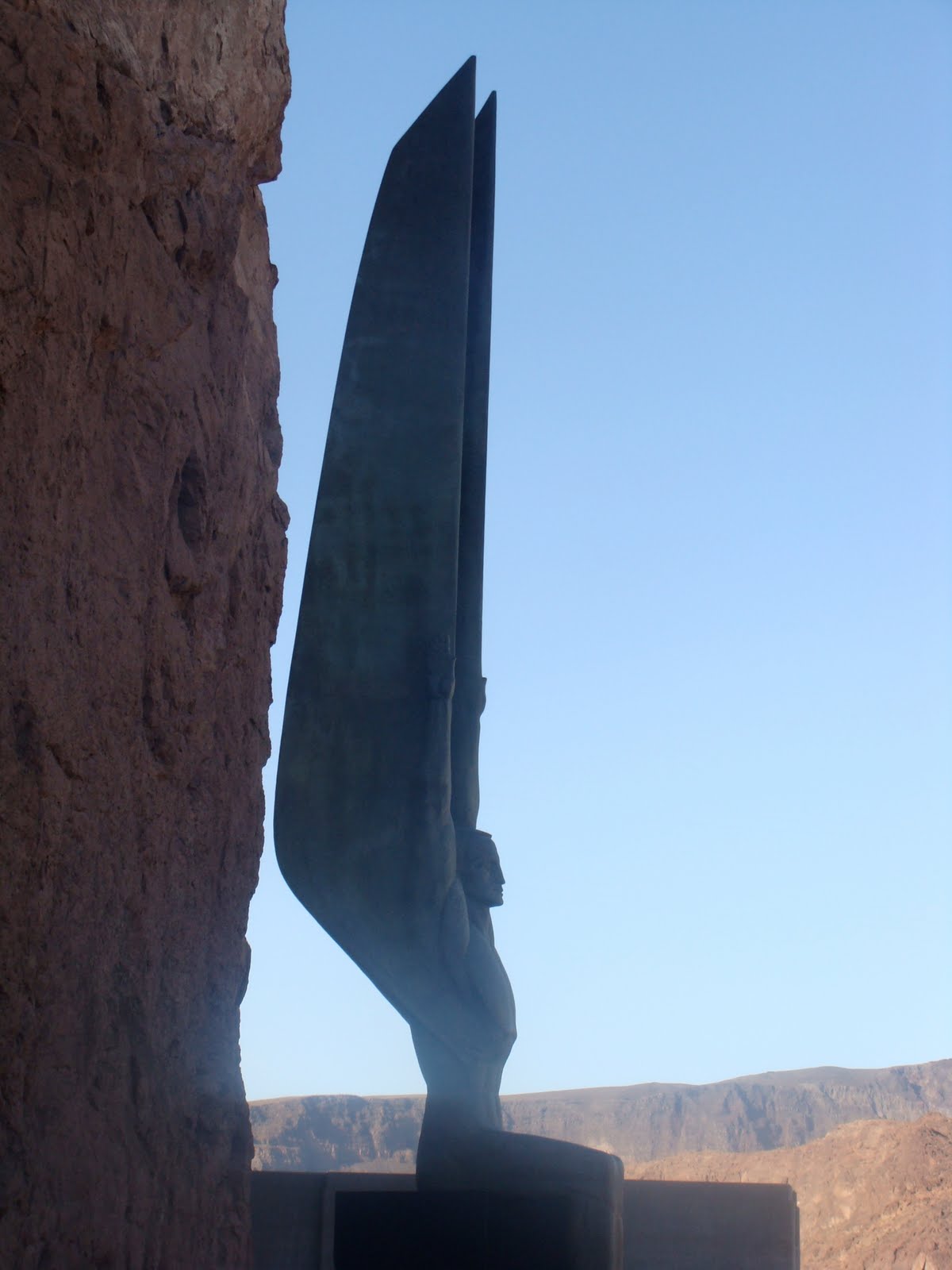
Our work is adaptive and multiple in that a given body of material can be configured as internet art, performance, installation, or public event. Our studio may be a public site, a gallery, a rehearsal room, a laptop, a server. It has therefore been ideal for us to work as artists-in-residence at Hyde Park Art Center which has generously provided both physical work-space and access to the building's external 10-screen digital facade, the largest of its kind in the country. We were in residence from April-June 2010 and will return from September-December when we launch a new large-scale digital work and stage a series of performance events both in the gallery and in the studio.  Our current work-in-progress is called The Precession. The seed of the work was planted when we took a trip to see the Hoover Dam and were struck by a site-specific sculpture commemorating the dam's improbable feat of construction. The sculpture, Oskar J.W. Hansen's 1935 Winged Figures of the Republic, depicts two 32-foot tall twin winged workmen seated within a complex celestial map.  The map engraved beneath their feet illustrates 209 stars visible in the night sky on the date of then-President Franklin Delano Roosevelt's dedication of the dam, a federally-backed public works project.  Hansen designed the sculpture with the idea that future civilizations or visiting extraterrestrials will be able to correctly decipher the date of its completion for millennia to come. The Winged Figures star map also charts the position and identity of the polestar as seen from Earth over 26000 years. What we perceive to be our polestar changes due to the slow and cyclical tilting of the earth's axis known as precession.


This chance encounter with a sculptural site within a sculptural site intrigued us with its rich references to the New Deal era, the laboring body, and the night sky. We detected the word recession contained within precession at a time when people were discussing with either great hopefulness or dread the advent of a “new new deal” with the relatively recent election of Obama. Our engagement with this source led us to study a diverse set of other sources including John Steinbeck's dust-bowl narrative, The Grapes of Wrath, the choreography of Bugsby Berkeley, a hoax poem called The Darkening Ecliptic, and a socially engaged genre of 1930's theater called the Living Newspaper.


We will here mention in brief summary a few instances of creative production throughout the development of this work-in-progress.


a. Initial Work-In-Progress on the Vernal Equinox
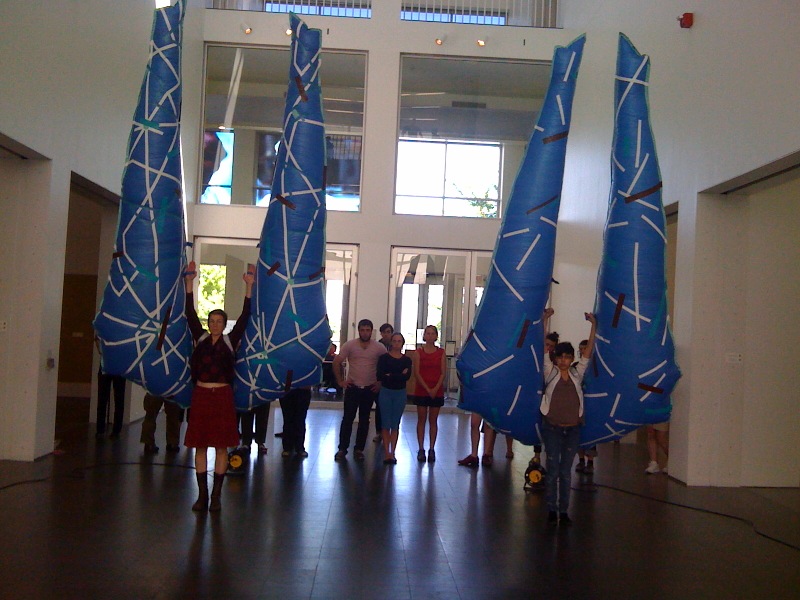
In March 2009, we were invited by Brown University and Firehouse 13 gallery in Providence, RI to work in-residence and end with a public showing of our progress. Over the course of 5 days we lived in the former firehouse developing performance sequences and digital material for projection.  We integrated volunteer performers from the community whose backgrounds related to our inquiry.  We included two physics students, an astrologer, a pole dancer, a fire twirler, a trumpet player, and  local playwrights who re-enacted a living newspaper play. We allowed the site itself – its history and  architecture -- to seep into the work. As we generated textual material, we posted this to our Twitter account and invited poet-friends and public followers to respond to us. We integrated their responses into the performance. We also 'tapped' the location for Twitter activity within a one mile radius of the firehouse, allowing local tweets to enter into our dialogue or appear in visualizations on-screen. Some of these tweets were spoken by us as we embodied an image of two winged figures with the help of a local artist who lengthened our arms with her construction skills. The event took place on March 20, the vernal equinox. Five minutes of edited material are available here.


b. The Living Newspapers @ MCA Chicago
This outgrowth of our overall project came at the invitation of curator Tricia Van Eck for her Hide-and-Seek series, an exhibition that playfully problematizes the distinction between art and the ordinary. The Living Newspaper, from which we derived our title, was a genre of socially engaged theater funded by the federal government in the 1930's. The plays were constructed from factual information on culturally pertinent topics such as the syphilis epidemic or the economic plight of farmers and were were often designed to educate or mobilize their audiences. With our MCA intervention, we wanted to re-engage this idea at a time of constant data consumption when anyone can become a persuasive transmitter of news.


Working with 32 volunteer performers, who we trained in a series of three-hour sessions, this piece consisted of pairs of 'museum visitors' seemingly engaged in pedestrian conversation. Their conversations, however, were actually comprised of real-time data harvested from Twitter. The performers in The Living Newspapers acted as subtle embodiments of the collective voice of social discourse.


The piece took place each day with pairs of performers in rotating shifts. The subtle activity was revealed as a performance twice daily, in the middle of each shift, when the performers transformed into two winged figures. The image constructed was based on the Hoover Dam sculpture, Winged Figures of the Republic.  Information on the Hide-and-Seek exhibition is available here.


c. Hyde Park Open Studio: In the Vicinity of the Hoover Dam, I hear...
We culminated the first round of our residency at Hyde Park Art Center with showings for small groups of friends and presenters in mid-June. We presented 50 minutes of material that had elements of digital poetry and interdisciplinary performance. The projected component included a textual panorama, 11.7 million pixels wide, created by algorithmically re-writing The Grapes of Wrath, and visualizations influenced by source material such as the Hoover Dam and the drawings of Sol Lewitt.  In the last three weeks of our residency, we worked with two young identical twin performers to embody our winged figures. For one 20-minute section of the performance, they stood on either side of the space, mechanically reciting texts that they received in earphones while we performed in the larger space of the studio. The texts they received were Twitter updates culled live from within a mile radius of the studio, or collected from the vicinity of the Hoover Dam, or they were texts chosen randomly from our databases of original and found writing.


Our HPAC blog entries to date are archived here.


This summer, as part of Radical Citizenship: The Tutorials, an ongoing series of artist-led events on governor's island in NYC, we will create an additional component of The Precession, a delegated dance in which 209 volunteer performers re-enact the choreography of Busby Berkeley with their physical positions dictated by the locations of visible stars overhead.


Our work attempts to engage the flux of contemporary, networked culture and to contain a complex diversity of material within rigorously defined forms and structures. We are interested in a variety of contexts, instances, and interruptions for the work to evolve and be staged as it moves towards something like completion across multiple platforms. Our studio is anywhere, but we still need a studio.


The Precession will be on view at Hyde Park Art Center from December 18 through March 2011. It is supported in part by a grant from the Illinois Arts Council, a state agency.


Judd Morrissey and Mark Jeffery are a collaboration merging digital literary practices and performance. The work, which is visual, textual and choreographic, evolves through context-specific research and practice and always considers the constraints of a given venue or occasion. Site- responsive considerations include the performance/exhibition/production space as well as the local community and [online] textual activity happening within the locale. A given piece is a body of material that may have no singular fixed form but is alternately or simultaneously presented as internet art, durational live installation, an ongoing activity, or a performance of fixed length. The two Chicago-based artists are currently in residence at Hyde Park Art Center working between the studio and the venue's 10-screen digital facade.

A new performance-based exhibition, The Living Newspapers, just completed its second run at the Museum of Contemporary Art. In this work, performers with earphones and a wireless device enact dialogue and choreographic sequences in response to information culled in realtime from the internet and converted to synthetic speech. Morrissey and Jeffery have presented throughout the US, UK, and Europe with recent venues including the Museum of Contemporary Art Chicago, Center of Contemporary Culture Barcelona, Landmark Cafe @ Bergen Art Museum, House of World Cultures Berlin, Chicago Cultural Center, Brown University, and the Ontological-Hysteric Theater in NYC.

Both artists were members of the Chicago-based international performance collective Goat Island, Jeffery as a performer and collaborator for 13 years, and Morrissey as an external collaborator on writing and digital art projects for 5. They both teach at the School of the Art Institute of Chicago.

For more info: http://www.judisdaid.com

All images were generously provided by Judd Morrissey and Mark Jeffery


Wednesday, June 30, 2010

Sculpture and the Studio of the Street


Jennifer Geigel Mikulay
Ph.D. in Visual Culture
Professor at Alverno College,
Milwaukee, WI

 
How do the streets of Chicago function as a studio? What may spring immediately to mind is the city’s fantastic heritage of public murals, architectural ornament, monumental sculpture, seasonal festivals, and frequent displays of what curator Mary Jane Jacob calls “culture in action.” Yet, most of these works arrive on the street only after prolonged periods of trial and error, incubation, dreaming, and planning, activities associated with the studio. Chicago’s most beloved works of public art—such as the downtown sculptures of Abakanowicz, Calder, Kapoor, Picasso, or Plensa, for example—were imagined in studios far from their ultimate siting. 

The relationship between public art and the studio seems somewhat unidirectional: artists envision and make their work away from public view and then present it as a final production.  Though work may be inspired by the activity of the street, most public art is not actually planned, refined, or made there. In fact, many artists do not find a need to engage local publics directly in the creation of public artworks.

Reception of public art is a different story. Response—a creative and critical process in its own right—begins on the street in the direct encounter between artwork and viewer. Could there be value in conceptualizing this space of openness and response itself as a studio? In the shadow of an outdoor sculpture, how do viewers imagine the range of possibilities for that work? How do these ideas emerge, find expression, change, and develop over time? Is the street an extension of the studio, rather than its opposite? If so, what does it mean to extend the domain of the studio to non-artists?
 

I recognized public art’s ability to convert the street to a studio in 2005 when Chicago photographers organized a protest of restrictive policies in Millennium Park by encouraging anyone and everyone to post images of Anish Kapoor’s Cloud Gate on Flickr. The sculpture’s reflective surface and highly accessible location instantly made it an appealing subject for photographers, but civic powers initially tried to control representation of the work. Within a matter of weeks, many thousands of images were shared on the web creating sufficient popular pressure to relax restrictions on photographing the work. Another key moment of recognition occurred when I participated in Milwaukee artist Paul Druecke’s 2006 project, A Public Space. Druecke challenged two dozen people from all walks of life to produce an image of Daley Plaza, and then he arranged an exhibition in the tunnel running beneath the plaza. Participating photographers looked at the monumental Picasso that is the plaza’s focal point, but they also looked away from it to turn attention on myriad activities also animating the site. Dan Wang’s catalog essay for the exhibition notes, “When viewing these images we must ask ourselves, What, exactly, is this space?”


Across any sculpture’s lifespan, public interaction stages surprising, unanticipated events. But, until recently, these responsive interactions were largely ephemeral or only recognized in private. The proliferation of mobile web-enabled devices in an increasingly digital culture facilitates greater awareness of what people actually make from their encounters with public art. The ubiquity of cell phones turns everyone into a photographer. Add Wi-Fi, and everyone is a publisher. Everyday life becomes a studio where anyone may produce images and texts expressing their experiences and observations. The production of these images and texts is creative activity, and the products themselves are artifacts of a sort of studio of the street.  

Public art can be a locus for experimentation and meaning-making activity. Response to public art is ongoing, and this response often takes visual forms produced by ordinary publics themselves. Artifacts of this response are a register for the quotidian contributions publics make toward understanding public art. The changing, constantly renewing, circulating responses to public art multiply the meanings that may be attributed to it—and reveal that claims to own and represent the work of public art are never final.


Jennifer Geigel Mikulay is a Milwaukee-based public art researcher. She holds a Ph.D. in visual culture from the University of Wisconsin-Madison. She recently joined the faculty at Alverno College. For more information visit www.mikulay.org. 

Photo Captions/Credits:
Cloud Gate by Anish Kapoor. Cloud Gate on a Cloudy Day photo by Anca Mosoiu. Accessed via Flickr.com (ancawonka’s photostream).

A Public Space: Daley Plaza 2006, a project by Paul Druecke. Installation view, Pedestrian Tunnel connecting Daley Center, Subway, and City Hall. Photo courtesy of artist.


Wednesday, June 23, 2010

Studio--What Studio?

Maggie Leininger
Collaborator/founder of
ARTivention


Working in a studio space always seemed clinical, sacred and self-righteous all at the same time.  As an undergrad, I had the opportunity to visit and work in a fair number of established artists’ studios.  Although each studio was very different from each other, I never felt that it was a space that I could envision producing meaningful work.  Then, once out in the real world, I attempted to designate a space in which I could work first as a room in my living space then in a converted garage/artist studio. But no matter how many hours I worked in that space the studio seemed a façade. I felt that the space between me and the place that I work was too separate, so I began working wherever I was comfortable. Eventually, this space expanded to everywhere I was…totally uncontainable.  Once I realized that the studio wasn’t or didn’t have to be this prescribed space, I took off making art in all sorts of spaces such as on the train as I went to and from work (the reality being that this was often the only time I had to make art) or in a tiny studio apartment balcony shared by three people while living in Japan.  I am, therefore I create was and is my motto to sustaining a dedicated practice to my visual and conceptual explorations.


Along with this understanding of my creative practice, something wonderful happened when I made art in public places.  People would come up and either stare at me trying to comprehend what on earth I was doing and what mental asylum I escaped from, or they would engage with me questioning my process and intent.  While at first these encounters were uncomfortable, I soon became addicted to these interactions.  I was getting direct feedback from real people, ones not often well versed in post-modern contemporary lingo.  Sometimes they understood what I was making or trying to say with a piece, other times they would just shrug, offer a “hmm” and walk away.  Simultaneous to this experience, I began teaching an intro to art class that attempted to explain why art is made, what function it serves and why it is valuable to approximately 240 students (all non-art majors) in one year.  This opportunity, as with many teaching opportunities, demanded a full understanding of subject matter.  For me, this meant finally answering a question that lurked around inside my head, “What is art and why is it important?” I was afraid to answer this question in fear that the whole house of cards, or purpose for my existence, would come tumbling down.  But these combined experiences of making art in public and teaching to non-art majors made me explore, delve deeper and find not only the answers I needed to educate students but also transform, sustain and enrich my work.


So, who is the audience?

By engaging with my students about their art experiences, I learned that while some do frequent museums and galleries, many do not.  Some students lived in Chicago their whole life and had never been to the Art Institute until I made it a mandatory field trip.  Other students who lived adjacent to Hyde Park had never heard of the Hyde Park Art Center, the Smart Museum or Little Black Pearl.  In another administrative position, I learned that one in four public schools in our city provide art education and many of them only partially through the year.  The last time that many adults had any interaction with art was as a pre-schooler when crayons and maybe watercolors were available.  The same students who I knew came from public schools with very little art instruction were the ones who grew up to be adults that only traveled within their immediate communities, not even aware of cultural resources on their campus let alone in the broader neighborhood.  It was during this time that the Stockyard Institute had a summer long exhibition/community dialogue at Hyde Park Art Center and I brought my students to experience something within relative proximity to them.  One of the exercises available was for viewers to fill in an outlined map of Chicago of where they situate themselves in proximity to the rest of the city.  All of the students lived within a 2 mile radius of 95th St., and all of them placed themselves in the center of the city—a place many had not even seen. 


Profoundly impacted by this experience, I knew then that while I still loved the precious moments of internal discoveries of playing in a private space, that a portion of my work must become dialogical and directly engage with people outside the art system of academia, curators, gallerists, collectors, colleagues, etc. If people are not exposed to art, then why would they vote for higher taxes to increase government funded programs that go into schools to enrich children’s artistic education and discoveries? Or seek out artistic explorations at the local arts center? Why pay money to see art in a museum? And how many people who visit larger institutions even understand what they are viewing?


Launching ARTivention

On a perfectly cool sunny mid-October day in 2008 I was sitting in a diner on the upper West side in Manhattan, and it hit me that what I needed to do was to start a movement—like the ones I always read about and drooled with envy that history placed me in this time and not in a prior one. While reading an article about Guantanamo refugees for the millionth time, I became so full of rage over the abuse of human rights, and the audacity of our government to presume that we had the right to overlook conventions that had been in place since World War II all in the name of terrorism.  I also felt very helpless.  After all, I was just an artist, what could I possibly do to make an impact?  But it was a time of great optimism as I headed off to work at a campaign booth and it was there that I knew that one person collectively could make a difference.  Out of this experience came ARTivention, a true collaboration between artist and public.  I say artist, because I want this to be about something larger than myself and invite others to take the lead as artist.  The goal of ARTivention is to connect to all community members and to not only gain insight to an artistic process or concept but to also provide a simple action to solving large problems such as human rights abuses, poverty, homelessness, environmental concerns, etc.  


The first project initiated by ARTivention was Care Packages.  Throughout November, December of 2008 and January 2009, I organized several workshops throughout the city inviting the public to help me construct 17 prayer mats for the Uighur refugees at Guantanamo Bay.  In addition to helping construct the mats, participants also were able to send a letter of protest via a link posted by the Human Rights Watch in opposition to the current practices of our government.  The mats were then packaged and shipped on the last day of the Bush administration.


The second project coalesced through ARTivention is Commune-ique.  This project began with the symbolism of wool for the three Abrahamic faiths and embodies communal diversity, individuality and awareness. Chicago maintains a diverse population, however, there is not a lot of crossover from one community into another.  Take for example the neighborhoods around California and Devon.  On one side it is a Hasidic Jewish population and on the other it is the closest proximity to India and Pakistan that many people will encounter.  Yet, these two worlds never seem to interact.  In response, Commune-ique is a portable structure made from hand-felted wool that is the site for durational art making experiences. 

The wool has been hand-felted by many individuals including transitional housing residents from Lincoln Park Community Services to visitors of the Arizona State University Art Museum.  The project also is an embodiment of collaboration between students from the School of the Art Institute and Roosevelt University.  On the days that the structure is placed in public, students from both schools will lead an interactive studio experience where the public will stitch individualized designs and marks onto cloth. What will happen to that cloth? It is hard to say, as this project is forever evolving and changing.  Will this structure and the resulting embellished fabric make it into the art system of galleries and educational museums? Probably.  But it will be in these direct public “non-art” locations that will sustain my interest as a maker, educator and member of society. As I write this one week prior to the installation of this structure, there are still many unanswered questions—all of which will only come throughout the actual experience itself.  And that is the best part about projects that leave the confines of the studio, gallery, museum or what ever establishment that they originate from.  They take on a life of their own.


Maggie Leininger is currently a visiting professor at Arizona State University in fibers and founder of ARTivention.  Previous experiences that have contributed to her outlook on art and the public include being manager of outreach and educator at Marwen Foundation, an artist in residence at Snow City Arts, and an adjunct faculty member at Chicago State University and Roosevelt University.  In addition to Commune-ique, ARTivention is also producing Found Objects that ask collectors/finders of miniature hand knit sweaters that are placed in public sites every day for a year to donate the value of the found object to the National Coalition for the Homeless. 


Link to ARTivention Blog: http://artivention.wordpress.com/
Link to website: http://maggieleininger.com/
Link to  ARTivention Face Book Page: http://www.facebook.com/#!/pages/ARTivention/53594511312


Stuff and the Studio

Jessica Cochran
Curator of Exhibitions and Programs
Center for Book and Paper Arts
Columbia College Chicago


In my room, No. 13 on the fifth floor of the Hotel Carcassonne at 24 Rue Mouffetard, to the right of the entrance door, between the stove and the sink, stands a table that VERA painted blue one day to surprise me.  I have set out here to see what the objects on a section of this table (…) might suggest to me, what they might spontaneously awaken in me in describing them: the way SHERLOCK HOLMES, starting out with a single object, could solve a crime….

-Daniel Spoerri, in An Anectocted Topography of Chance


I recently began working at the Center for Book and Paper Arts as Curator of Exhibitions and Programs, and so I have been spending ample time thinking about artists’ books as they relate to just about everything- contemporary art production, discourse, literature, me, curatorial practice, Chicago, and, of course, the studio.  The following blog post is about an artist’s book project that relates to the studio in a big and fantastic way.  A big thanks to Steve Woodall, director of The Center for introducing me to this project.   


In 1961, Fluxus artist
Daniel Spoerri initiated the project An Anecdoted Topography of Chance, for which he pieced together a written history for 80 objects found on a blue table in his Paris hotel room, where he lived with his wife Vera.  His and the reflections of several friends, including artist Dieter Roth, and anecdotes for each object were compiled into an artist’s book- a choppy and extensive text that relayed the discursive nature of his table and its “chance” constellation of material objects.


The list of objects is long, and it certainly made for a crowded table.  Candles, screws, coffee, tubes, corks, nails, knives, wine, jars, pens, paper clips, crumbs, stains, matches and jars are just a few of the items chronicled, and, though I am not sure if he had a different studio, they suggest that this residence certainly functioned productively.  Page after page, the objects are points of departure for stories, memories, exchanges (between Spoerri and the other contributors), inside jokes and definitions.  Some entries are merely a sentence, and others go on for pages.

For example, the entry for ‘chunk of white bread’ looks like this:


Why does Spoerri’s artist’s book, a self-reflexive and ambitious undertaking, provide a useful framework for thinking about the studio today?  In short, because studios are places where stuff matters.  They will always be places where stuff matters. To that end, in the introduction to The Social Life of Things, Arjun Appadurai discusses things and how they gain meaning by way of human transaction and interaction. 

Even if our own approach to things is conditioned necessarily by the view that things have no meanings apart from those human transactions, attributions, and motivations endow them with, the anthropological problem is that this formal truth does not illuminate the concrete, historical circulation of things.  For that, we have to follow the things themselves, for their meanings are inscribed in their forms, their uses, their trajectories.  It is only through the analysis of these trajectories that we can interpret the human transactions and calculations that enliven things.  (Appadurai, 5)


In other words, embedded within the exchange of objects is the “flow of social relations”(Appadurai, 11). As an artwork Spoerri’s book carefully tells his history of social relations as they are held in certain objects.  The loaf of bread that had a slice cut out from is the starting point for the beginning of a narrative-- a visit by someone named Renate Steiger.  Futher investigation might tell us who Steiger was, and why he was there.  To that end, the term ‘chance’ in his book title only partially explains the objects on the table.  They really are a deliberate practice made visible: an ongoing series of decisions that result in works of art, and an artist’s life lived. 


That Spoerri presents this project as an artist’s book is significant.  According to Johanna Drucker
, the artist’s book throughout the 20th century has often served as document.

As a document, the book becomes a space of information. (…) This use of the book seems almost obvious, something one can take for granted.  In fact, the forms by which their presentation is realized ranges from banal to the extraordinary… (Drucker, 335)

Spoerri’s project is inherently relational, but its discursive nature is manifest in an ‘extraordinary’ book form much more effectively than if he had created a painting, series of photographs or sculpture.  It allows for typographic liberties, and myriad narratives- both layered and broken.   The book is bound by two covers, which physically contain a beginning and an end. And finally, the reception of his work is amplified for that the act of reading a book is at once investigative and intimate, making it easy to fully engage in the text’s stops, starts, twists and turns.  From concept to form, the work is resolved, and we can really explore the objects on Spoerri’s table. 


It seems to me, that Spoerri’s project reflects how an artist’s personal objects can be granted truly dynamic agency by an artist, as opposed to a curator, critic or historian.  But even more remarkably, as an artist’s book it expansively makes visible the dialogic process by which that stuff in the studio begins to gain meaning in relation to artwork and vice versa. As Kirsten Swenson points out in her essay, Potraits of the artist with work: Eva Hesse, the studio “emerges as not so much a place for work, but as a place for displaying, staging and acting, while also functioning as a compendium of external sources (…) (the) studio is anything but cloistered; it is a crossroads of diverse practices and source as much as  it is a private space of production.”  In other words, the studio is where objects gain symbolic value and narrative currency, and this happens by way of studio visits, talking, people visiting, artists hanging out.

In a deeper reading, his project is an art object—and from start (his first written anecdote about a piece of white bread) to finish (an artist’s book that was also the exhibition catalog for a related commercial gallery show)—it is kind of a double agent.  It maps out for us both actively (in its text, which describes its coming into being) and passively (through its own life as an artwork) how art objects gain momentum as art.   After all, the legitimization of any art in the field of production is nothing if not a social project. 


Or, maybe in the end it’s just about the life of his stuff; his stuff, and our stuff- the things that clutter our creative spaces.  And what’s great about that?  I’ll tell you.  All the while-- in our studios, administrative offices, writers’ lofts, junk drawers, bedrooms, “rooms of our own,” and kitchens alike-- the objects we keep around us continue to shift and change-- from handwritten letters to printed out emails, record players to iPods, and Wonder Bread to Whole Foods baguettes.  At the end of the day, though, they are just our lovely vessels, and the stories stay pretty much same. 


A view of my father’s home library/exercise room/storage room in Minnesota- he is a scientist, a keeper of stuff.  Each time I visit, I check to see what new objects have moved or been added, or what might be missing. 


How can everyday life be defined?  It surrounds us, it besieges us, on all sides and from all directions.  We are inside it and outside it. 
-Henri Le Febvre, in Clearing the Ground (1961)


Works Cited:
Spoerri, David. An Anecdoted History of Chance. London: Atlas Arkhive Four, 1966.

Appadurai, Arjun. The Social Life of Things. Cambridge: Cambridge University Press, 1988.

Drucker, Johanna. The Century of Artists' Books. New York City: Granary Books, 1994.

Swenson, Kirsten. "Portraits of the artist with work: Eva Hesse.” The Fall of the Studio: Artists at Work. Ed. Wouter Davidts and Kim Paice.
Valiz, 2009. 


Jessica Cochran is currently Curator of Exhibitions and Programs at the Center for Book and Paper Arts (Columbia College Chicago), and Director of Exhibitions at the O'Connor Art Gallery (Dominican University).  She has previously worked for Art Chicago/NEXT as Director of Marketing and Programs and Around the Coyote as Visual Art Coordinator.  Her writing has appeared in Proximity, Newcity, CS and Curating Now.